
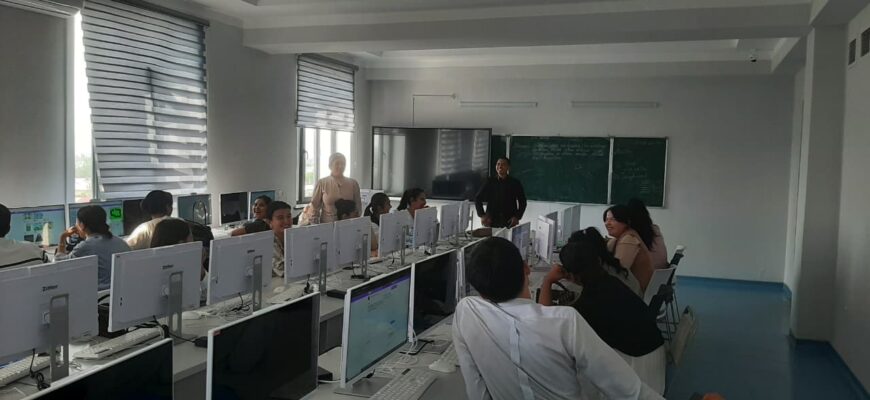
Universitas Muhammadiyah Gresik (UMG) introduced a different learning atmosphere at Shahrisabz State Pedagogical Institute on Thursday, April 30, 2026. Through a team teaching activity, the classroom evolved into an active discussion space exploring how technology shapes modern education and business practices.
Carrying the theme “Optimizing ERP in Education and Business in Shahrisabz,” the session went beyond theory by connecting Enterprise Resource Planning (ERP) to real organizational practices.
ERP was presented as a system that integrates multiple functions—ranging from finance and human resources to academic services and data management—into a single unified platform. This approach introduced a new perspective: organizations, including universities, operate as interconnected systems rather than isolated units.
M. Zainuddin Fathoni explained that understanding ERP is not only about mastering technology, but also about developing a mindset that connects data, workflows, and decision-making processes. Students were encouraged to understand how each activity within an organization influences others.
He further emphasized that digital transformation cannot begin with technology alone. Organizations must first understand their business processes, identify inefficiencies, and restructure workflows before using technology as a tool for integration.
“Students need to understand ERP as a tool to see how an organization works as a whole. In the digital era, economic competence must be connected with data literacy, technology, and business processes,” he stated.
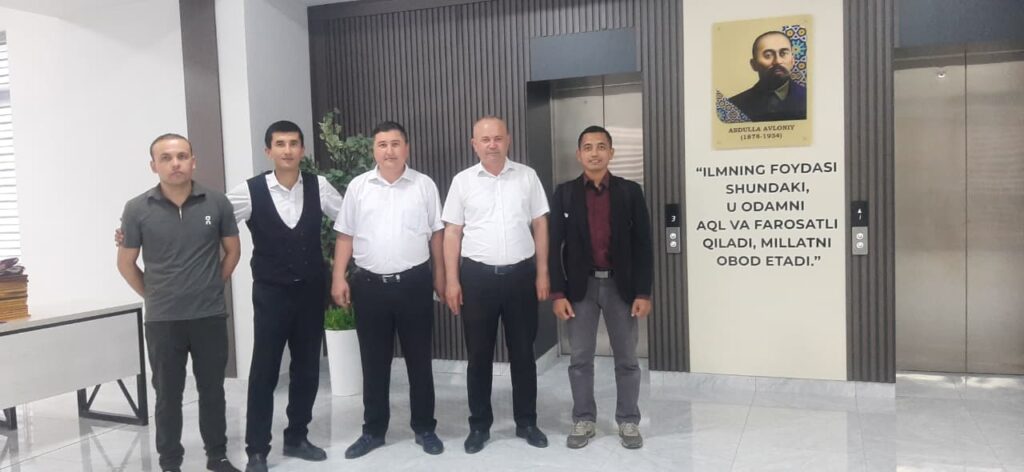
Meanwhile, Prof. Dr. Farukh Kodirov Ergas Ugli noted that this approach is highly relevant to current student needs. According to him, higher education must provide more applied learning experiences to prepare students for the increasingly digital demands of the workforce.
The discussion became dynamic as students began linking ERP to various contexts, from university systems to business environments. They explored how a single decision within an organization can affect other components when all processes are interconnected.
The session also highlighted real-life applications of ERP, including student data management, financial systems, operations, and reporting. This demonstrated that ERP is not only about efficiency but also about enabling data-driven decision-making.
Learning activities were designed to be more practical through case studies, simulations, and business process mapping. Through this approach, students were not only introduced to concepts but also gained insight into how systems function in real situations.
One participant, Azbek, stated that the session provided a new perspective on the relationship between technology and educational governance.
“Through this activity, I learned that technology is not only used to speed up work. ERP also helps us understand how different parts of an organization are connected, allowing decisions to be made based on clearer data,” he said.
Another student, Tursunov Sherzodjon, noted that the material was valuable because it connects technological learning with business needs.
“For us, ERP is important because the workplace requires people who not only use technology but also understand organizational processes. This class helped us see how data, business, and education are interconnected,” he explained.
Overall, the activity reflects a shift from purely theoretical learning toward more contextual and practice-oriented approaches. Students were able to see ERP not only as a concept but as a system actively used in real-world settings.
For Universitas Muhammadiyah Gresik (UMG), this initiative represents a step toward strengthening students’ digital competencies through international collaboration. Meanwhile, for Shahrisabz State Pedagogical Institute, it enriches teaching approaches to better align with the needs of modern organizations.
More than just formal cooperation, this collaboration has moved directly into the classroom. ERP serves as a learning bridge, connecting students with the realities of the digital workforce.