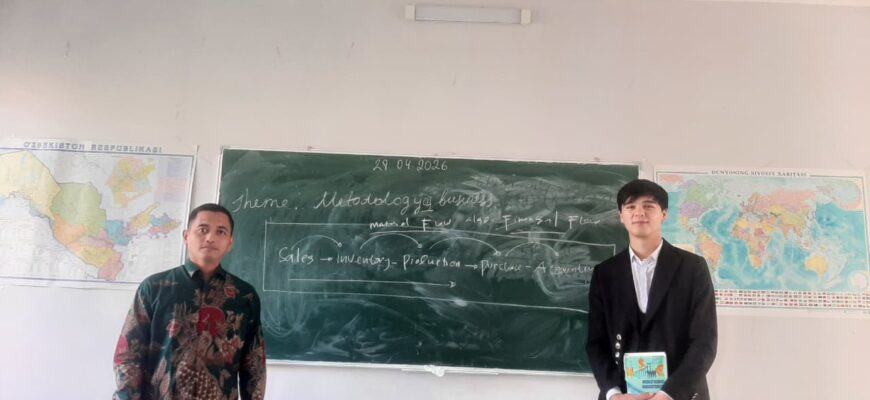
At the Department of Economy at Katakurgan State Pedagogical Institute on Tuesday, 28 April 2026, academic discussion moved beyond traditional classroom boundaries as Universitas Muhammadiyah Gresik (UMG) and its Uzbek partner explored how digital transformation is reshaping economics education.
The sharing session centered on the theme “Enhancing Student Competence in the Digital Era through Open-Source ERP.” Rather than treating ERP (Enterprise Resource Planning) as a purely technical concept, the forum positioned it as a practical bridge between economic theory and real-world organizational systems.
ERP was discussed as an integrated digital system that connects key organizational functions such as finance, human resources, operations, and reporting within a single platform. This integration allows students to understand how decisions in one part of an organization directly affect other components in real time.
M. Zainuddin Fathoni highlighted that modern economics education can no longer rely solely on theoretical understanding. According to him, students must also develop digital literacy, data awareness, and the ability to interpret business processes within integrated systems.
He further emphasized that open-source ERP systems play an important role in education because they provide more accessible learning opportunities without the limitations of expensive commercial software. This allows students to engage directly with system structures and workflows in a practical learning environment.
“Students need to understand ERP as a tool to see how an organization works as a whole. In the digital era, economic competence must be connected with data literacy, technology, and business processes,” said Moh. Zainuddin.
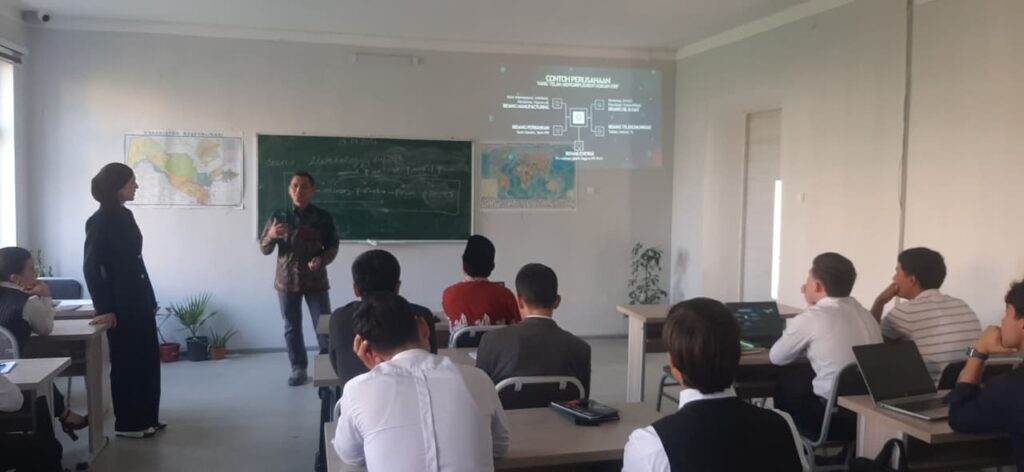
Dr. Azizah Nilufar added that integrating technology into economics education is no longer optional but necessary. She noted that the global job market increasingly demands graduates who are familiar with digital systems and data-driven decision-making.
She also underlined that the collaboration between UMG and Katakurgan State Pedagogical Institute creates a space for mutual academic exchange, where both institutions can learn from each other’s approaches to digital learning and curriculum development.
The discussion became more interactive as students explored practical applications of ERP in small businesses, educational institutions, and modern organizations. Questions emerged regarding the differences between commercial and open-source ERP systems, implementation challenges, and the skills required for future economic professionals.
One participant, Quvonchbek, expressed that the session provided a clearer understanding of how technology is embedded in economic systems. He noted that ERP helps students connect theory with real-world business operations.
“Through this activity, I learned that technology is not only used by large companies. Students can also understand how business processes work through open-source ERP systems. This is important for preparing us for the digital job market,” he said.
Overall, the program reflected a shift in economics education toward a more applied, technology-integrated approach. The collaboration between UMG and Katakurgan State Pedagogical Institute is expected to continue through joint teaching materials, applied research, guest lectures, and academic publications in digital economics.
The initiative marks a transition from formal academic cooperation into more practical, classroom-based implementation, where open-source ERP becomes a learning bridge between Indonesian and Uzbek students in preparing for the global digital economy.