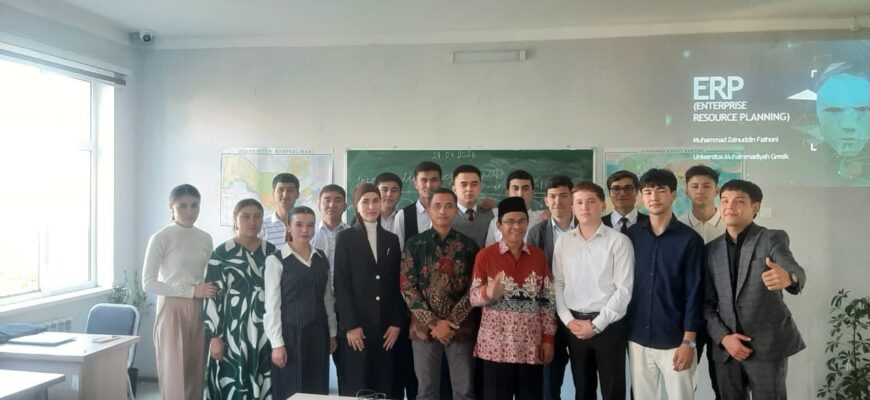
KATTAKURGAN, 28 April 2026 — Universitas Muhammadiyah Gresik (UMG) led an academic workshop at the Department of Economics, Kattakurgan State Pedagogical Institute, Uzbekistan, focusing on the integration of productive waqf and Enterprise Resource Planning (ERP) as two strategic approaches to strengthening modern economic governance based on social values and digital transformation.
Held on Tuesday, 28 April 2026, the program is part of UMG’s strengthened international academic collaboration with educational partners in Uzbekistan. The workshop featured Dr. Azizah from Kattakurgan State Pedagogical Institute, Dr. Tumirin from UMG presenting productive waqf, and M. Zainuddin Fathoni, M.MT. from UMG discussing ERP implementation in organizational management systems.
At the opening session, Dr. Azizah emphasized that contemporary economic education requires the integration of economic theory, governance, and digital transformation in student learning processes. “Economic learning today must be able to respond to real-world challenges, not only in concepts, but also in how systems operate within organizations,” she stated.
In the first session, Dr. Tumirin explained productive waqf as a socially driven economic instrument with strong potential to support education, healthcare, and community empowerment. He stressed that waqf should no longer be viewed solely as traditional philanthropy, but must be managed professionally and systemically.
“Waqf holds significant economic potential if properly managed. The key lies in governance, transparency, and sustainability to ensure long-term impact,” Dr. Tumirin said.
He further highlighted that waqf should be positioned as part of a broader socio-economic ecosystem connected to financing and community development systems.
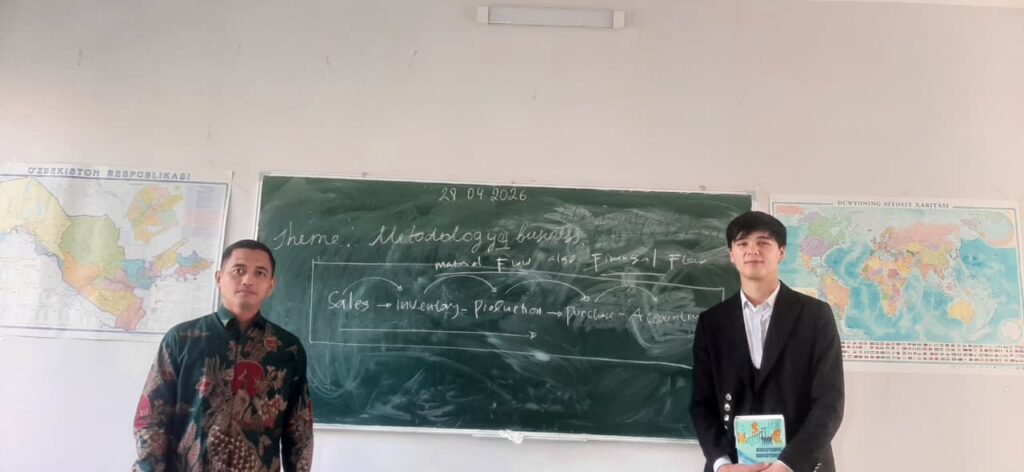
In the second session, M. Zainuddin Fathoni presented ERP as an integrated information system that connects core organizational functions such as finance, human resources, production, and supply chain management into a unified real-time data platform. He explained that ERP plays a crucial role in improving efficiency, data accuracy, and decision-making quality in modern organizations.
“ERP enables all organizational processes to be connected within a single system. Decisions are no longer based on assumptions, but on integrated and real-time data,” he explained.
He also highlighted the growing use of open-source ERP systems such as Odoo, which offer flexibility and efficiency, particularly for educational institutions and small to medium-sized organizations.
The workshop further explored the connection between the two approaches. Productive waqf was positioned as a driver of social and sustainable economic value, while ERP was highlighted as a tool for improving efficiency, transparency, and accountability in organizational governance.
Although rooted in different frameworks, both approaches were presented as complementary elements in strengthening modern economic governance systems.
From an academic perspective, the event reflects UMG’s active role in promoting economic learning that integrates theoretical knowledge, social values, and digital systems within a comprehensive educational framework.
One participant, Quvonchbek, noted that the workshop provided a broader understanding of economics beyond traditional perspectives. “I learned that economics is not only about profit, but also about how systems work and how social values can align with technology,” he said.
The activity forms part of UMG’s ongoing international academic collaboration with partners in Uzbekistan in developing more comprehensive, adaptive, and globally relevant economic education.