
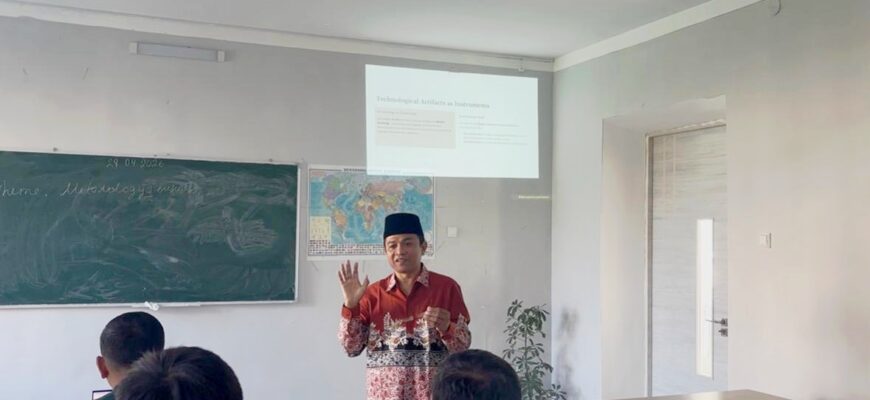
UZBEKISTAN, April 28, 2026 — The discourse on Sharia economic research methodology is evolving toward a more integrative and reflective direction. This shift was highlighted in an academic forum held at the Department of Economics, Kattakurgan State Pedagogical Institute, where a qualitative research approach grounded in tauhid values was introduced as an alternative framework to better understand economic phenomena.
In this forum, the academic contribution of Universitas Muhammadiyah Gresik (UMG) became a key highlight through the presentation delivered by Dr. Tumirin. He introduced the concepts of tauhid-based hyperphenomenology and post-phenomenology as methodological approaches that go beyond conventional empirical analysis by incorporating meaning, values, and spiritual awareness into economic research.
Unlike conventional approaches, this perspective views economic activities as inseparable from ethical values such as honesty, trustworthiness, and social responsibility, as well as the relationship between humans and God. Therefore, Sharia economic research is expected to capture these dimensions in a more comprehensive manner.
The hyperphenomenology approach focuses on exploring the lived experiences of economic actors, including their intentions, meanings, and underlying consciousness. Meanwhile, post-phenomenology provides a framework to analyze the interaction between humans, technology, and economic systems in an increasingly complex modern context.
Through this perspective, digital transformation in the economic sector is not seen as a neutral process, but as a force that shapes how individuals think, make decisions, and construct values within their economic activities.
Methodologically, participants were introduced to research stages that involve identifying relevant phenomena, collecting data through in-depth interviews, observations, and focus group discussions, and analyzing findings by interpreting meanings, social relations, and tauhid-based values embedded in human experiences.
The FGD session was highly interactive, with students actively raising questions regarding the distinction between conventional qualitative research and Sharia-based approaches, as well as strategies to maintain objectivity in value-oriented research.
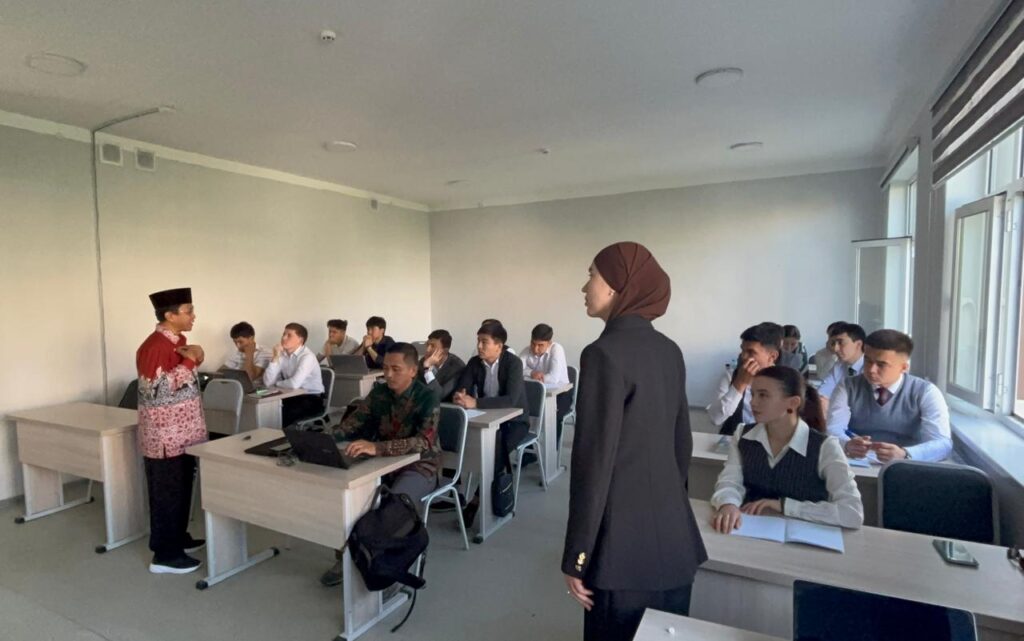
One participant, Yusupova Gulnoza Ma’rufjon qizi, stated that the workshop provided new insights into Sharia economic research. She emphasized that economic research should not only focus on transactions and profit but also on values influencing human behavior.
“This workshop helped me understand that Sharia economics can be studied through human experiences. Values such as honesty, trustworthiness, and social responsibility can become essential parts of the analysis,” she said.
Another student, Ziyodullayeva Jasmina Ziyodulla qizi, mentioned that the approach introduced by Dr. Tumirin offered a new perspective in developing research topics, making them more connected to real-life contexts.
“I see this method as very useful for studying economic practices in everyday life. Research is not only about explaining data, but also about understanding the reasons, beliefs, and values that exist in society,” she explained.
Meanwhile, To‘rayeva Sevinch Umidjon qizi highlighted the practical benefits of the FGD, especially for students preparing their academic research. “This activity gave us a clear picture of how to start research. We learned how to choose phenomena, design questions, and interpret interview results from a Sharia perspective,” she added.
This academic engagement reflects a growing shift in Sharia economic research toward a more holistic approach that integrates academic rigor, social realities, and spiritual values.
Through this forum, the collaboration between UMG and Kattakurgan State Pedagogical Institute goes beyond institutional partnership, opening opportunities for joint research, academic exchange, and the development of more contextual and impactful studies in the field of Sharia economics at the global level.