
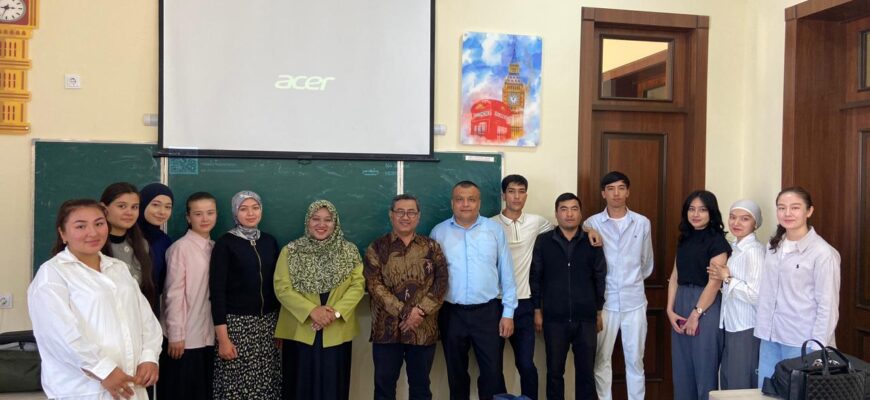
KATTAKURGAN, April 28, 2026 — Not just a collaboration on paper, Universitas Muhammadiyah Gresik (UMG) has truly implemented internationalization in a real and impactful way. Held at Kattakurgan State Pedagogical Institute (KSPI), Uzbekistan, this collaboration stands out through a team teaching program that directly engages classroom practice and students’ learning experiences.
This initiative is far from ordinary. The two main topics—English for Academic Purposes (EAP) and language testing strategy—were carefully selected as essential tools for students to survive and compete in an increasingly demanding global academic environment.
In the first session, Prof. Dr. Khoirul Anwar from Universitas Muhammadiyah Gresik (UMG) delivered the material on English for Academic Purposes (EAP) and immediately reshaped students’ perspectives on English. He emphasized that at the university level, English is no longer just about everyday communication, but about academic thinking.
“Being able to speak is not enough. Students must be able to read arguments, evaluate evidence, write in a structured way, and present ideas academically,” he stated.
Through EAP, UMG positions English as an intellectual foundation rather than merely an additional skill. Students were guided to understand how academic texts are constructed, how arguments are analyzed, and how critical responses are developed responsibly.
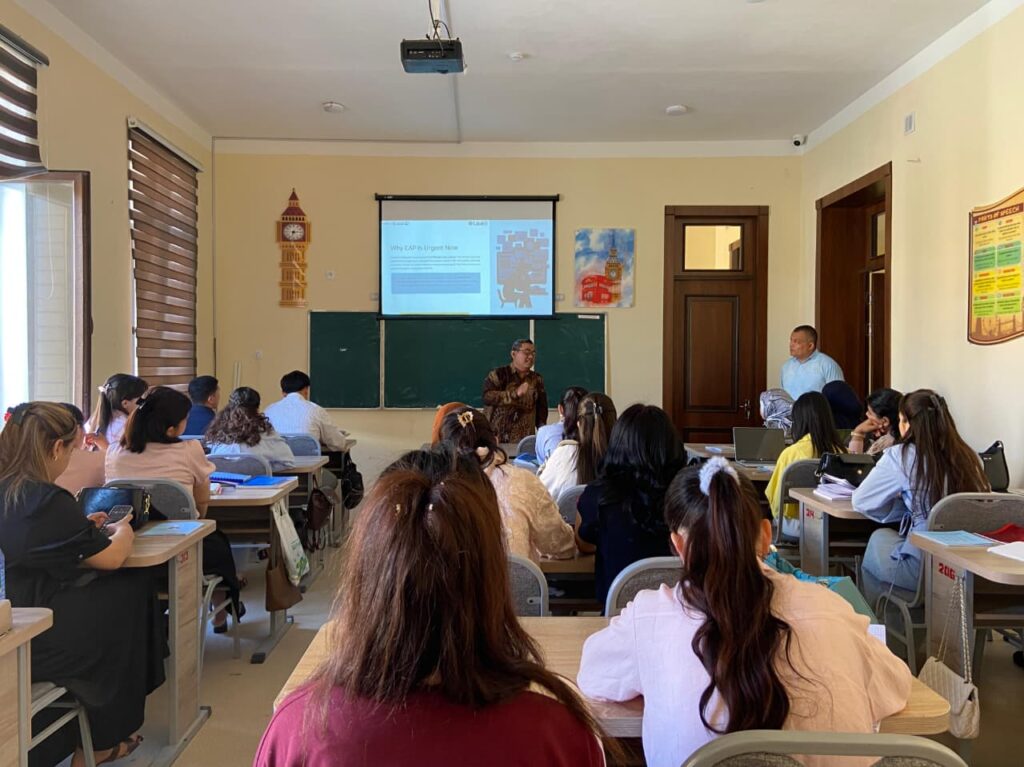
The classroom atmosphere became even more dynamic as the second session began. Paulina, M.Pd. from Universitas Muhammadiyah Gresik (UMG) delivered the session on language testing strategies using an interactive and practical approach, encouraging students not only to listen but also to actively engage in understanding assessment concepts. She explained that language tests should not be seen merely as grading tools, but as instruments to identify students’ learning needs.
“Tests are not just about scores. They help us understand students’ needs and improve the learning process,” she explained.
She introduced various types of tests, including placement, diagnostic, achievement, and proficiency tests, while emphasizing the importance of selecting appropriate assessment strategies.
The collaboration was further strengthened by the active involvement of Dr. Sherzod Yuldashev, a lecturer from Kattakurgan State Pedagogical Institute (Uzbekistan), who directly participated in the teaching process. He highlighted that this team teaching model offers a unique learning experience beyond conventional classroom practices.
“Our students do not only receive knowledge, but also witness how two academic perspectives—from Indonesia and Uzbekistan—interact and complement each other,” he stated.
The impact of this program was clearly felt by students of Kattakurgan State Pedagogical Institute (Uzbekistan) as the main participants. Salzadov shared that his perspective on English has significantly changed—from merely speaking fluently to understanding and constructing academic arguments.
Veroza, a student of Kattakurgan State Pedagogical Institute (Uzbekistan), stated that the session on language testing strategies helped her realize that each type of test serves a different purpose in the learning process.
Selvina, another student of KSPI, emphasized the importance of EAP as preparation for further studies and participation in international academic forums.
Meanwhile, Sabrina expressed that interacting directly with lecturers from Universitas Muhammadiyah Gresik boosted her confidence in using English in academic contexts.
More than just a program, this activity demonstrates that the internationalization of higher education does not always have to take the form of large-scale ceremonies. In a classroom in Kattakurgan, Uzbekistan, international collaboration becomes more meaningful—through the exchange of ideas, cross-cultural teaching approaches, and real learning experiences.
From Uzbekistan, UMG delivers a clear message: students should not only be trained to communicate, but also to think critically, write academically, and actively contribute to global academic discourse.
And through this team teaching initiative, that mission is already in motion.